
How a Convenience Feature in an Agritech Platform Became a Tenant Data Breach Waiting to Happen
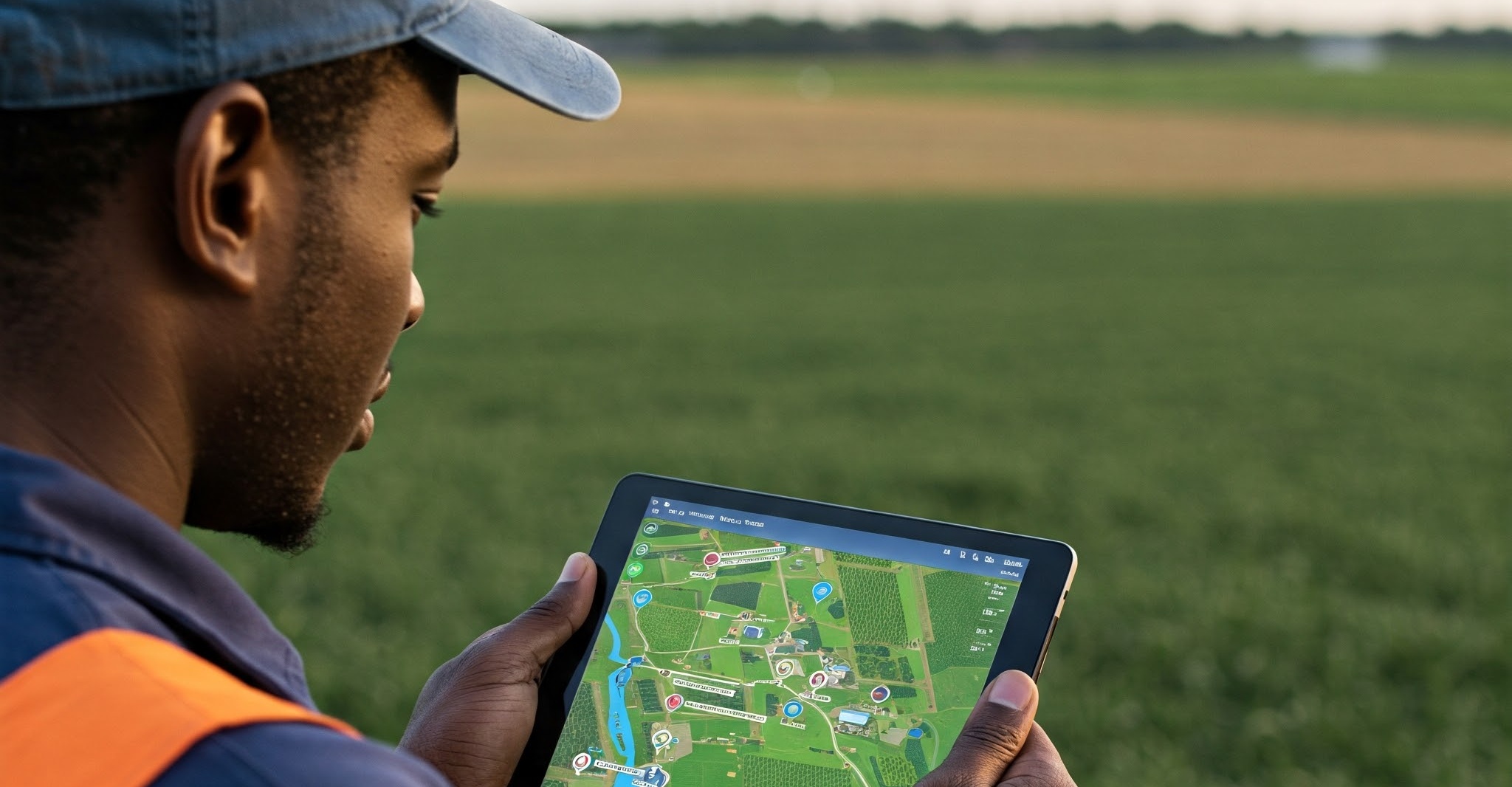
The chatbot had a help menu.
It was thoughtfully designed. Pre-built query commands sat in a dropdown at the bottom of the interface,that is; quick-access buttons that let farm managers ask the platform natural-language questions without typing. Weather today. Soil moisture now. Irrigation schedule this week. Yield forecast this season. Click a button, get an answer. Frictionless, convenient & user-friendly; more like having your farm in your pocket.
It was also, beneath the friendly interface, a multi-tenant data breach with a toolbar.
What the platform’s developers had built as a convenience layer – pre-formatted queries routed through a chatbot interface, was passing tenant identifiers through URL parameters without any server-side verification, that the requesting user was authorised to access the tenant they were querying. The chatbot trusted what the URL said. The database answered. And every farm on the platform was, in principle, one manipulated URL away from being an open book to any other authenticated user.
Constructed Case Study - Educational Framing: This article presents a constructed scenario, a composite of real vulnerability patterns documented across multi-tenant SaaS and agritech platforms globally. No specific vendor, product, or implementation is described or implied. The vulnerability class, attack mechanics, exploitation steps, and remediation guidance are technically accurate and drawn from published OWASP research, CVE disclosures, and documented BOLA case studies. This is security education through realistic narrative, a format established in the information security community by OWASP, academic researchers, and independent security professionals worldwide.THE TECHNICAL ANATOMY OF WHAT WAS WRONG
To understand the vulnerability, it helps to understand how the chatbot interface was built. Rather than constructing queries from the authenticated user’s session context, the way a properly designed multi-tenant system should work; the chatbot passed a tenant identifier as a URL parameter that the query engine used directly.
A legitimate request from an authenticated farm manager looked something like this:
https://platformxyz.example.com/chat?tenant=farm_A&query=weather_today
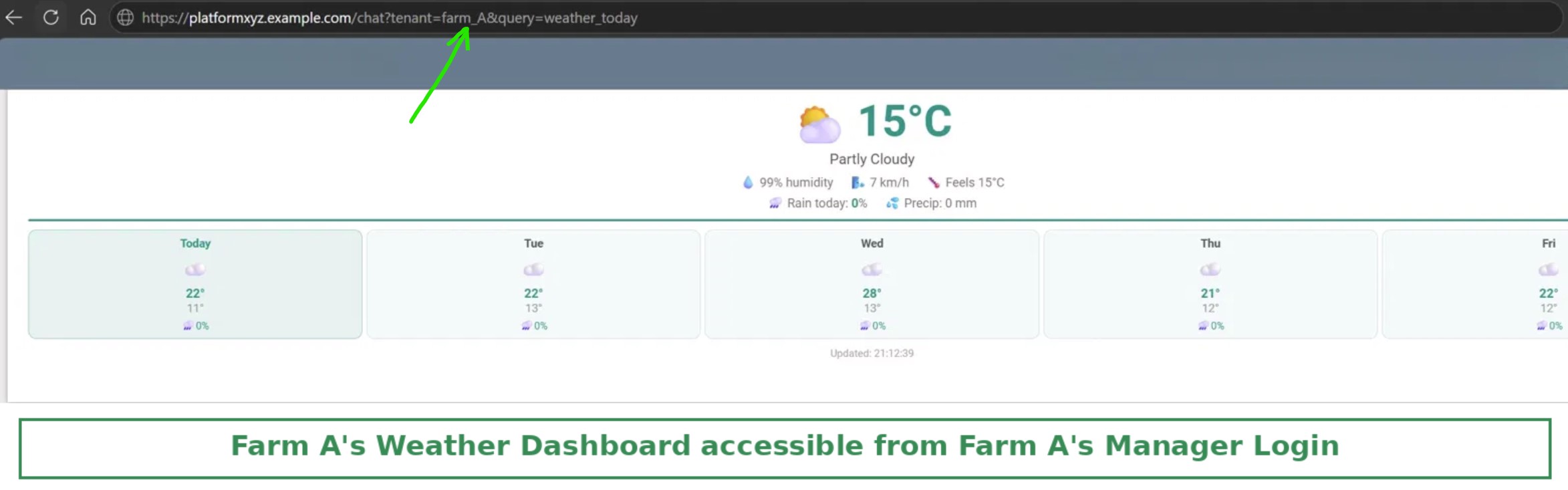
The platform received this request, looked up the weather data for farm_A, and returned it to the user. Logical, fast and I must say, did the job – functional.
The security assumption baked into this design was that only farm_A’s authenticated users would ever send a request with tenant=farm_A. But that assumption was never enforced. The platform checked whether the user was authenticated. It never checked whether the authenticated user was authorised to query the tenant they had specified.
The manipulation required no tools, no scripts, and no technical sophistication beyond knowing what to look for in a browser address bar:
https://platformxyz.example.com/chat?tenant=farm_B&query=weather_today
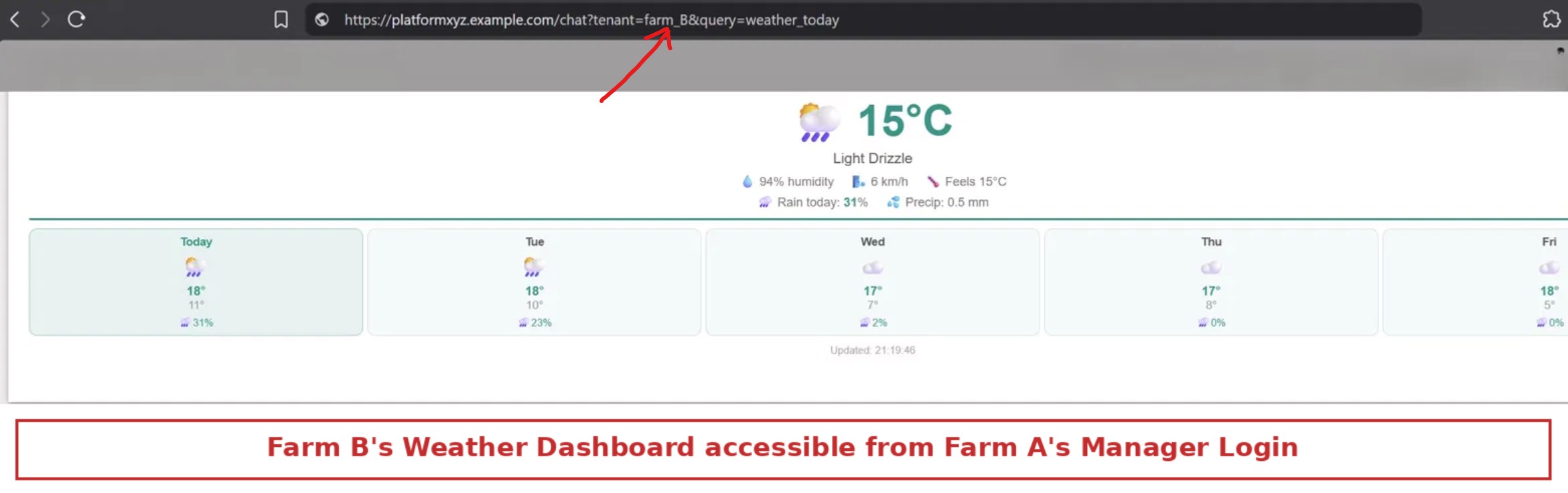
Farm B’s weather data. Returned to farm A’s authenticated Farm Manager. No error, no warning and no log entry flagged as anomalous. The system behaved exactly as designed, it just should not have been designed this way. Farm A’s predicted weather on day is 15 degrees celcius, no chances of rain. Farm B also accessed from Farm A’s Farm Manager’s login (which should not be the case); shows 15 degrees celcius & 31% chance of rain. The above could any dashboard; showing even more sensitive information e.g. Farm Overview.
Security Finding: This is OWASP API Security Top 10 – API1: Broken Object Level Authorization (BOLA). OWASP ranks it as the number one API vulnerability class by prevalence and ease of exploitation. It requires no advanced tooling, only a browser, a basic understanding of URL parameters, and the willingness to change a number. The agritech platform had shipped with it in production, in a user-facing feature.
THE ENUMERATION PROBLEM – PRE-BUILT COMMANDS AS AN ATTACK MAP
What made this particular implementation especially vulnerable was not just the missing authorisation check. It was the combination of the missing check with the pre-built query command library.
The chatbot’s help menu was, from a security perspective, a documented attack surface. Each pre-built command revealed a query endpoint, its expected parameter format, and the type of data it returned. A malicious user who discovered the tenant parameter manipulation did not need to guess what queries to run. The platform had listed them all in a convenient dropdown.
| Pre-Built Command | Intended Use | What It Exposed With Tenant Manipulation |
| Weather today | Current weather at farm location | Another farm’s location, GPS coordinates, and microclimate data |
| Soil moisture now | Current sensor readings for my fields | Another farm’s live sensor readings – zone by zone |
| Irrigation schedule | This week’s planned irrigation runs | Another farm’s full irrigation programme and water volumes |
| Yield forecast | Predicted harvest volumes for my crops | Another farm’s yield projections – commercially sensitive pre-harvest intelligence |
| Sensor history | My historical soil data | Another farm’s complete historical dataset – months of proprietary soil intelligence |
| Farm overview | Summary of my farm status | Another farm’s complete operational profile – crop types, zone layout, sensor deployment |
The platform had documented its own attack surface in a user-facing help menu. Every pre-built command was a query path. Every query path could be redirected to another tenant. The help menu was not a user experience feature. It was a catalogue.
THE TENANT ENUMERATION – FROM ONE FARM TO EVERY FARM
The BOLA vulnerability was serious enough in isolation; one authenticated farm manager could query another farm’s data if they knew or guessed the tenant identifier. But the attack surface was compounded by a second weakness: tenant identifiers were enumerable.
The platform used sequential or predictable tenant identifiers, not random UUIDs that would make enumeration impractical. An authenticated user who discovered the tenant parameter manipulation could iterate through tenant values systematically:
?tenant=farm_001 → farm data returned
?tenant=farm_002 → farm data returned
?tenant=farm_003 → farm data returned
?tenant=farm_004 → {error: tenant not found} → no farm registered here
?tenant=farm_005 → farm data returned
The error response on an unregistered tenant effectively confirmed which IDs were valid – a technique known as tenant enumeration. Within a modest number of requests, an attacker could map the complete list of farms registered on the platform, then systematically query each one using the pre-built command library.
Technical Detail: This is OWASP API9 – Improper Inventory Management, combined with OWASP API1. Sequential tenant IDs make enumeration trivial. Random, non-guessable UUIDs (v4) would make this attack significantly harder; an attacker would need to guess from a pool of approximately 5.3 x 10^36 possible values rather than iterating from 001 upward.
THE FIVE ATTACK STEPS – WHAT A MOTIVATED ATTACKER WOULD DO
The full exploitation path required no specialist tools, no vulnerability scanner, and no prior knowledge of the platform’s internal architecture. It required only an authenticated account, which any registered farm on the platform would have, and a browser.
Step 1 Authenticate
Register for a free or paid account on the agritech platform. Obtain a legitimate session. From the platform’s perspective, you are a normal farm manager using the product.
Step 2 Discover the parameter
Use the pre-built query commands. Watch the URL change when a command is clicked. Observe that the tenant parameter appears in the URL and corresponds to your own farm identifier. This takes approximately 30 seconds in any browser’s address bar.
Step 3 Test the assumption
Change your tenant ID to a different value. Submit the modified URL. If the platform returns data rather than an authorisation error, the vulnerability is confirmed. This is the single test that reveals whether tenant isolation is enforced.
Step 4 Enumerate tenants
Systematically iterate through tenant ID values. Log which return data and which return errors. Build a map of all registered farms on the platform. Automate with a script if desired; manual iteration is feasible for platforms with fewer than a few hundred tenants.
Step 5 Extract at scale
Using the pre-built command catalogue as a query guide, run each command against each enumerated tenant. Weather. Soil. Irrigation. Yield. Sensor history. Farm overview. Every farm on the platform is now an open data source accessible to any authenticated user.
WHAT DATA WAS AT RISK
The data exposed through this vulnerability was not generic or low-sensitivity. Agricultural data on a precision farming platform carries commercial, operational, and personal information that farmers have a reasonable expectation will remain private.
- Yield forecasts – pre-harvest production estimates that have direct commodity market value. A competitor or trader with access to this data can make informed pricing or purchasing decisions before the farmer has harvested.
- Irrigation schedules – operational intelligence revealing farm management practices, crop types, growth stages, and water usage. In water-scarce regions, this data has both competitive and resource-management sensitivity.
- Soil sensor history – weeks or months of proprietary baseline data that a precision farmer has invested in collecting. This data has commercial value and represents competitive advantage in soil management.
- GPS-linked field data – sensor placement reveals field layout, crop zone delineation, and infrastructure location. In contexts with land tenure disputes or physical security concerns, this is sensitive location intelligence.
- Farm operational profile – crop types grown, technology deployed, farm size, and management approach. This is competitive intelligence for input suppliers, land buyers, and agricultural competitors.
Implication: Under South Africa’s POPIA, farm operational data linked to an identifiable natural person constitutes personal information. A platform that allows unauthorised cross-tenant access to this data is in breach of its data protection obligations; with exposure to Information Regulator enforcement, fines, and civil liability to affected farmers.
THE OWASP VULNERABILITY FINGERPRINT
This incident maps cleanly across multiple entries in the OWASP API Security Top 10 2023 – demonstrating that real-world exploits rarely involve a single vulnerability in isolation.
| OWASP Category | Vulnerability | How It Appeared in the Chatbot | Severity |
| API1 – BOLA | Broken Object Level Authorization | Tenant ID in URL path accepted and processed without ownership verification, any tenant could query any other tenant’s data | Critical |
| API3 – BOPLA | Broken Object Property Level Authorization | Pre-built query commands returned full farm data objects including sensor readings, irrigation schedules, and crop plans belonging to other tenants | Critical |
| API9 – Improper Inventory | Undocumented enumeration endpoints | Tenant ID enumeration via URL parameter injection exposed the full list of registered farm tenants on the platform | High |
| API8 – Misconfiguration | Security misconfiguration in chatbot layer | Chatbot query interface did not apply the same authentication context enforcement as the core API – separate attack surface with weaker controls | High |
| API6 – Sensitive Flows | Unrestricted access to sensitive business flows | Pre-built query commands designed for convenience created predictable attack patterns – weather today, soil now, irrigation schedule; each returning cross-tenant data | High |
WHY AGRITECH PLATFORMS ARE PARTICULARLY VULNERABLE TO THIS PATTERN
BOLA is the number one API vulnerability globally, not just in agritech. But the agritech context creates specific conditions that make it more likely to exist and less likely to be caught.
Development Culture and Security Expertise
Most agritech platforms are built by developers with deep domain expertise in agriculture and relatively limited exposure to API security principles. The concept of server-side ownership verification for every object request is not intuitive to someone whose primary mental model is soil sensors and irrigation schedules. BOLA is a category of vulnerability that security-aware developers avoid instinctively. Developers without security training create it without realising it.
Convenience Features as Security Vulnerabilities
The pre-built query command library was a genuinely good user experience decision. Farm managers who are not technically fluent benefit enormously from click-to-query interfaces that return natural-language answers. The feature failed not because it was a bad idea but because it was implemented without security review. The same features that make a platform accessible to non-technical users – simplified interfaces, pre-formatted queries, URL-based parameters, also make its attack surface more accessible to non-technical attackers.
The Multi-Tenant Architecture Gap
Building a genuinely secure multi-tenant architecture requires deliberate design decisions from the earliest stages of development. Tenant isolation is not something that can be bolted on after the product is built. It requires a consistent, platform-wide enforcement mechanism – middleware that extracts the tenant context from the authenticated session and applies it to every database query, without relying on user-supplied parameters.
Many agritech platforms were not designed with this discipline from day one. The tenant parameter in the URL was a shortcut; functional, fast to implement, and fatally flawed; big time!
THE FIX – WHAT CORRECT IMPLEMENTATION LOOKS LIKE
The vulnerability has a well-understood remediation. It is not complex. It requires changing where tenant context comes from and never trusting it from user-supplied input.
Extract Tenant Context from the Authenticated Session
When a user authenticates, the session token issued by the platform should encode the user’s tenant affiliation. Every subsequent API request should extract the tenant context from that session token NOT from a URL parameter, request body field, or any other user-controllable input.
// WRONG - tenant from user-controlled URL parameter
const tenantId = req.query.tenant;
const data = await db.query('SELECT * FROM farm_data WHERE tenant_id = ?', [tenantId]);
// CORRECT - tenant from authenticated session
const tenantId = req.session.user.tenantId; // set at authentication, not user-controlled
const data = await db.query(‘SELECT * FROM farm_data WHERE tenant_id = ?’, [tenantId]);
The difference is one line. The security implication is complete tenant isolation. A user cannot query a different tenant’s data because the tenant ID is determined by who they authenticated as NOT by what they type in a URL.
Replace Sequential IDs with Non-Guessable UUIDs
Even with session-enforced tenant context, sequential tenant identifiers create enumeration risk. Replace them with version 4 UUIDs; randomly generated identifiers from a space of approximately 5.3 x 10^36 possible values. An attacker who discovers a BOLA vulnerability faces a search space that makes enumeration computationally impractical.
// Sequential ID - enumerable
tenant_id: 'farm_042'
// UUID v4 - non-enumerable
tenant_id: 'f47ac10b-58cc-4372-a567-0e02b2c3d479'
Return Identical Error Responses for Unauthorised and Non-Existent Resources
An error response that distinguishes between ‘this tenant does not exist’ and ‘you are not authorised to access this tenant’ provides enumeration information. Both cases should return an identical 404 Not Found response, making it impossible for an attacker to determine whether a tenant ID is valid by observing the error type.
Implement Rate Limiting on Chatbot Query Endpoints
Even with the above controls in place, rate limiting on the chatbot query interface prevents automated enumeration attempts. A legitimate farm manager making natural-language queries generates a predictable, low-volume request pattern. Hundreds of sequential requests to the same endpoint with incrementing parameters is not a usage pattern; it is an attack signature.
THE CHATBOT AS AN EXPANDING ATTACK SURFACE
This incident points to a broader trend that agritech security practitioners need to understand: the addition of conversational AI interfaces to data platforms creates new attack surfaces that sit outside the security controls applied to the core API.
When a platform adds a chatbot layer on top of its existing API, the chatbot becomes a new entry point into the data layer. If that chatbot enforces a different, or weaker authentication and authorisation model than the core API, it creates a bypass path that attackers will find. The chatbot interface is not just a user experience layer. It is an API client. It deserves the same security scrutiny as any other API client.
Insight: As agritech platforms add AI-driven chatbots, natural language query interfaces, and conversational farm advisors, each addition requires a full security review of the authentication and authorisation model it uses to access underlying data. The friendlier the interface, the more important the security controls behind it.
WHAT THIS MEANS FOR AFRICAN AGRITECH FARMERS
The practical implication of this vulnerability, before it was identified and (presumably) addressed, is that a farm’s most sensitive operational data was accessible to any other authenticated user on the same platform. Not through hacking. Not through technical sophistication. Through a URL parameter change that any curious user might stumble upon.
Yield forecasts. Soil intelligence. Irrigation strategy. Crop plans. The data that precision farming generates and that smart farm platforms promise to secure; all of it, potentially visible to competitors, input suppliers, land agents, or anyone else with a platform account and a few minutes of curiosity.
This is why agritech security is not a peripheral concern. It is a direct threat to the commercial viability of precision agriculture. The value proposition of a smart farm platform depends entirely on the farmer’s trust that their data is theirs. A platform that cannot enforce that trust is not a smart farm platform. It is a shared spreadsheet with a chatbot on top.
The pre-built commands were convenient. The URL parameter was efficient. The missing authorisation check was invisible. And every farm on the platform was one parameter change away from being open to anyone who noticed.
On Security Education and Responsible Disclosure
This article uses a constructed narrative scenario built from real, documented vulnerability patterns: a methodology with a long tradition in security education used by OWASP, academic researchers, and independent practitioners. The scenario is fictional. The vulnerability class is real. The attack mechanics are real. The remediation is real. Presenting a realistic scenario is more effective for educating developers and platform operators than abstract technical documentation alone, and is standard practice in information security writing.
If you discover a real vulnerability of this type in a platform you use, the correct path is private disclosure to the vendor, a reasonable remediation window (90 days is standard), and public documentation only after the fix is confirmed. My personal approach: document the finding, contact the vendor privately, provide technical detail sufficient for remediation, agree a timeline, verify the fix, and publish the vulnerability class – never the vendor name, for the benefit of the broader agritech security community.
References
OWASP API Security Top 10 2023 – API1: Broken Object Level Authorization. owasp.org/API-Security/editions/2023/en/0x11-t10/
Vulnsy (2026). Broken Object Level Authorization (BOLA) Vulnerability. vulnsy.com
Redbot Security (2025). BOLA Explained: Broken Object Level Authorization Risks and API Security Best Practices. redbotsecurity.com
InstaTunnel / Medium (2025). Multi-Tenant Leakage: When Row-Level Security Fails in SaaS.
CVE-2026-30855. Broken Object Level Authorization in Tencent WeKnora – multi-tenant BOLA in LLM-powered framework. cvereports.com
CVE-2024-1313. BOLA vulnerability in Grafana affecting 20+ million users. Published 2024.